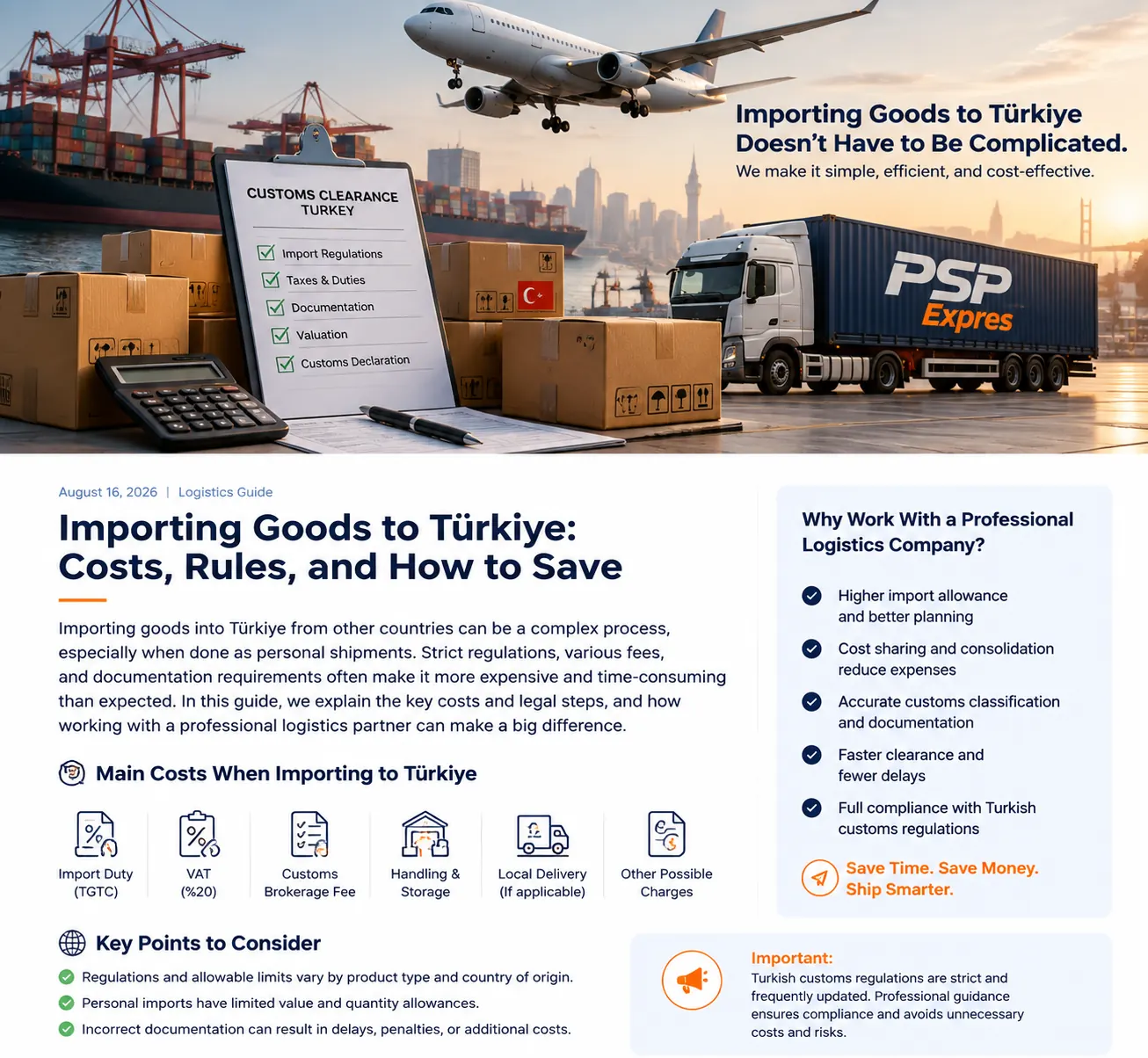
Importing personal goods to Türkiye: Costs, rules and the right route
Labelling a shipment “personal goods” does not automatically exempt it from tax or import rules. The procedure in Türkiye depends on how the goods arrive, their value, weight, quantity, nature and intended use.
Goods carried by a passenger and goods sent by post or express carrier are not governed by the same route. For most personal goods sent by post or express carrier, assuming a general tax-free allowance is wrong. Increasing quantity can also cause a shipment to be treated as commercial.
Identify the correct import route first
Passenger-accompanied goods
Goods carried with a passenger and goods sent by post, express carrier or commercial transport are not assessed under the same rules. Passenger-accompanied arrangements cannot be transferred directly to cargo shipments; each shipment must be reviewed according to its product details and transport method.
Post or express carrier
A low invoice value does not automatically make a shipment eligible for a simplified or electronic declaration route. Product type, quantity, intended use, origin, packaging and permit requirements are assessed, and even a low-value item may require customs procedures and additional controls.
Normal/commercial import
Goods that are commercial by quantity, nature or intended use, or that require product-specific permits and conformity checks, may enter the normal import route. HS classification, origin, product safety, permits and conformity controls are assessed by product.
What counts as “personal goods” for customs?
The recipient being an individual, or an invoice saying “personal goods”, is not decisive. Customs can assess the commodity, count, quantity, packaging, repeated shipments and intended use together. Multiple identical units can trigger a commercial-nature assessment even if the recipient says they are not for sale.
Main costs you may face
Customs and additional customs duty
Rates vary by HS code, origin and preferential trade documentation. There is no single rate for every country or product.
VAT and excise where applicable
The VAT rate and any excise obligation depend on classification; one fixed percentage should not be applied to every shipment.
Freight and insurance
Transport costs to the place of entry in Türkiye can be added to customs value. Where freight is not shown separately, a deemed transport amount may be included under the applicable rules.
Declaration and customs representation
Detailed declaration, HS classification, document preparation and representation can create service fees.
Storage, terminal and handling
Storage may accrue while cargo waits, alongside loading, unloading, weighing, examination and terminal charges.
Conformity and extra documents
Testing, surveillance, permits, health/origin documents, translations or laboratory costs may apply by product.
Final delivery
Transport from the airport or terminal to the final address is normally priced separately.
Prepare these before the shipment starts
- ✓ Commercial invoice or genuine proof of payment
- ✓ Packing list with package count, dimensions, net and gross weight
- ✓ Clear technical description, brand/model and intended use
- ✓ HS code and country of origin where available
- ✓ Transport document and freight amount
- ✓ Additional technical/conformity documents for used, battery-powered, chemical, food, cosmetic, medical or electronic goods
When does a larger volume make sense?
Bringing more units under a ‘personal’ label is not a safe cost-sharing strategy. As quantity grows, commercial nature, product-safety and normal-import obligations become more likely. A legitimate advantage can arise by consolidating several suppliers logistically while classifying the shipment under the correct commercial route from the beginning, preparing documents once and spreading fixed operating costs over a larger volume. This does not remove taxes; it may reduce per-unit logistics cost and avoidable errors.
Restricted or higher-risk product groups
Shoes, toys and leather goods were restricted from Türkiye’s simplified postal/express declaration route under a measure effective 20 October 2025. Used goods may also require permission or product-specific checks. Food, supplements, medicine, cosmetics, electronics, batteries and radio-enabled devices may trigger permits or additional controls. HS classification and product rules should be checked before purchase and transport begin.
What a professional logistics company can—and cannot—do
✓ Check documents and packing data before arrival
✓ Compare transport and consolidation alternatives
✓ Coordinate HS code and permit checks with a customs broker
✓ Track timing to reduce storage risk
✓ Make freight, terminal and final-delivery items visible
× Eliminate statutory taxes
× Turn commercial quantities into personal goods through wording
× Guarantee acceptance on behalf of customs or another authority
Frequently asked questions
Is there one fixed tax-free limit for personal parcels?+
No single tax-free threshold can safely be assumed for every shipment. Product type, quantity, intended use, origin and the applicable product rules must be assessed together.
Is every low-value parcel released easily?+
No. Even a low-value item may require customs procedures or additional controls because of its type, quantity, technical characteristics or permit requirements.
Is freight included in customs valuation?+
Transport to the place of entry in Türkiye is added to value. For postal/express goods, an imputed amount may apply when freight is not shown separately.
Does marking a parcel as a gift create an exemption?+
No. Customs can examine the product's actual nature, value, quantity and intended use; the word 'gift' does not create an exemption by itself.
Will bringing more units reduce my cost?+
Per-unit logistics cost may fall for some commercial cargo, but higher quantity can make the shipment commercial. Calculate the economics under the correct import route.
Official sources and currency note
This article was reviewed on 19 August 2026 against current explanations from the Republic of Türkiye Ministry of Trade. Tax rates, import communiqués and product restrictions can change. Before shipment, the HS code should be checked with an authorised customs broker and the relevant authority.
Visual summary of the article